 It rained the other night in Boston. Or said another way…it RAINED the other night in Boston. Six inches in two hours! At times the rain was so loud it sounded like a freight train. I lay in bed listening and smiling, thinking of my Wahoo! in its slip, warmed by the thought of the two bilge pumps I’d installed this past year (one in the deck drain basin and one in the true bilge), doing their job. No worries.
Until I remembered that the day before I’d taken the battery out of the boat and brought it home to charge it. Shoot.
It being a weekday, I had to go to work that morning and couldn’t check on the boat until later. All day I wondered if I’d find it full of water up to the gunnels or worse. It wasn’t though. I walked out onto the dock that evening to find it bobbing in its slip. Well not bobbing, exactly. Actually the stern was sitting pretty low in the water. I hooked up the battery and the pumps went to work, removing about 100 gallons of water, most of it from below deck.
Once the season is over and I have more time I’ll write a lot more about the Wahoo!s plumbing…the supposedly self-bailing system, the deck drain, the true bilge, what drains into where and so on. It’s one of the most confusing aspects of these boats and one of the most asked about by Wahoo! owners. For now, though, I’ll just say that in my (limited) experience: A) If you keep your Wahoo! in the water you most definitely need a bilge pump, and quite likely two; B) Even if you don’t keep it in the water you may prefer a pump in the deck drain basin to Wahoo!s self-bailing design; and C) Rule pumps…ummm….rule. They are rugged, dependable workhorses. And made right here in the great state of Massachusetts. 🙂
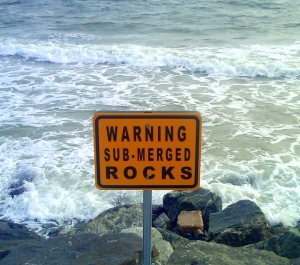 Launched the boat today for the first time since pulling it out of the water for engine repairs four weeks ago (a story in itself for another time). I launched from the Nahant Town Wharf intending simply to test out the engine after the repairs and then dock at my slip at the Point of Pines Yacht Club two miles away. Wind was moderate out of the southeast and, as the tide was low and there are some rock piles along that route, I kept my speed down and my eye on the depth finder. After rounding Bass Point I headed out towards open water. The finder was showing a steady seven feet so I opened her up a little and suddenly BAM!!!! The whole boat shuddered and stopped. I didn’t know what happened…thought maybe a couple of the engine mount bolts failed–that’s how severe the shock was. But looking down over the side I saw right away I’d run onto a rock pile and had struck a large rock. I was in two to three feet of water but the depth finder still read seven feet. Killed the engine, titled it up, and sat there a little dumbfounded as the wind and current pushed me away from the rocks, feeling very sheepish and wondering just how badly I’d injured myself.